 Available in GB
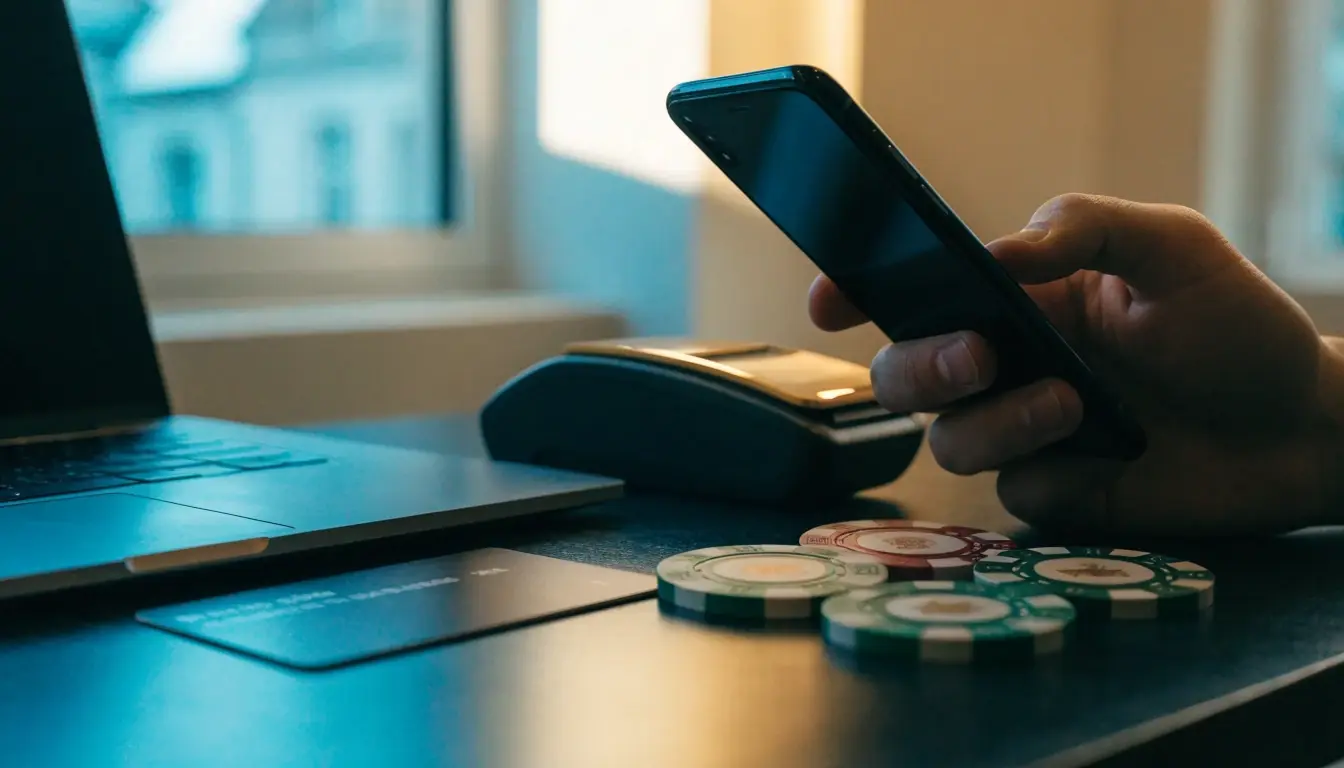
See how e-wallets compare with cards and bank payments, and what to check about fees, withdrawals, promotions and limits.
How E-Wallets Fit into UK Casino Payments
An e-wallet adds an account between you and the casino. Instead of paying from a debit card or bank account directly, you use a separate payment service to move funds. That extra step can make the wallet feel distinct from familiar card and bank options, but it does not make it a universal route: the casino and the payment service both need to support the transaction.
For UK players, the comparison is practical rather than abstract. Debit cards, including Visa and Mastercard, are commonly accepted at casinos. A card payment uses the card details and account associated with your bank, while an e-wallet payment draws on the wallet account. Bank transfers and open banking provide another route from your bank. Each method sits in a different place between your money and the casino cashier.
The direct route: debit cards
A debit card is familiar because it links a casino payment to a bank account without requiring you to use a separate wallet balance. If you already use a card for ordinary online purchases, the basic payment route may feel straightforward. UK casinos commonly accept debit cards, including Visa and Mastercard, although the payment choices shown to you still depend on the individual cashier.
If you’re looking for a UK casino that accepts e-wallets in 2026, check the payment options available to you and the stated payout timing before choosing. The details here provide a limited reference point, not confirmation of any specific e-wallet.
1. WinBeast
Payout speed: 1-3 business days
WinBeast lists a payout speed of 1–3 business days. Check directly whether your e-wallet is supported.
2. x3bet
Payout speed: 1-3 business days
x3bet lists a payout speed of 1–3 business days. Check directly whether your e-wallet is supported.
3. NightLuck
Payout speed: 1-3 business days
NightLuck lists a payout speed of 1–3 business days. Check directly whether your e-wallet is supported.
4. SpinFormula
Payout speed: 1-3 business days
SpinFormula lists a payout speed of 1–3 business days. Check directly whether your e-wallet is supported.
5. Jetsetspins
Payout speed: 1-3 business days
Jetsetspins lists a payout speed of 1–3 business days. Check directly whether your e-wallet is supported.
6. EvoSpin
Payout speed: 1-3 business days
EvoSpin lists a payout speed of 1–3 business days. Check directly whether your e-wallet is supported.
7. BeOnBet
Payout speed: 1-3 business days
BeOnBet lists a payout speed of 1–3 business days. Check directly whether your e-wallet is supported.
8. NightWin
Payout speed: 1-3 business days
NightWin lists a payout speed of 1–3 business days. Check directly whether your e-wallet is supported.
9. SlotoSport
Payout speed: 1-3 business days
SlotoSport lists a payout speed of 1–3 business days. Check directly whether your e-wallet is supported.
10. Britsino
Payout speed: 1-3 business days
Britsino lists a payout speed of 1–3 business days. Check directly whether your e-wallet is supported.
An e-wallet changes that arrangement: you select the wallet as the casino payment method, rather than entering card details as the direct route. That can be useful if you prefer to keep casino payments within a separate payment account. It is not automatically simpler, though. You are dealing with another account and another service, so the wallet itself must be available and usable for the payment you intend to make.
The distinction is worth keeping clear. A casino accepting cards does not thereby accept every e-wallet, and a wallet being familiar to you does not mean it will appear in that casino’s cashier. A payment method is useful only when the particular casino offers it for your account. Familiarity is not compatibility.
The bank route: transfer and open banking
Bank transfers and open banking services connect casino payments with your bank through a different route from a card or wallet. They may be presented as options in the cashier alongside those methods. A specialist review reports that open banking and bank transfers can support instant deposits and fast withdrawals at many sites; treat that as a description of some offerings, not a promise about every casino or transaction.
Compared with a wallet, a bank-based option keeps the payment closer to your bank account. Compared with a debit card, it uses a transfer or open-banking route rather than a card payment. The labels can sound similar because the money ultimately relates to your bank, but the payment method shown at the cashier matters: a bank transfer and a card payment are not interchangeable simply because both draw on a bank account.
Casinos That Accept Giropay in the UK: What to Check · Casinos That Accept USDC in the UK: Payment Checks
This broad map helps explain why online casinos with e-wallets may also offer more familiar payment choices. The wallet is one part of a wider cashier, not a replacement for cards or banking. Some players may value a separate payment account; others may prefer the directness of a debit card or the bank-linked route. There is no winner without a criterion. The route that fits depends on the job you want the payment method to do.
What “accepting e-wallets” means
When a casino says it accepts e-wallets, that describes a payment category, not a guarantee that every wallet service is available. Nor does the label alone tell you whether a particular method can be used for every kind of transaction. The relevant choice is the one the casino actually displays in your cashier, for your account and intended payment.
That is why “best” needs a measure. If your priority is using a separate payment account, an e-wallet may be the more relevant option to investigate. If you want a familiar bank-linked route, a debit card may be a better fit. If you are comparing bank-based services, look at the transfer or open-banking option actually offered. A general label cannot settle those differences for you.
You can use an e-wallet at an online casino only where the casino and wallet support the relevant payment route. The same principle applies to cards and bank transfers: a method’s existence in the wider market is not proof that it appears at every cashier. Start with the payment choices the casino presents, then compare them with the account you want to use. Simple enough. Not universal.
A payment method is only useful when the particular casino offers it for your account; familiarity with a wallet does not guarantee its compatibility with a specific casino cashier.
E-wallets therefore sit between two familiar alternatives: the directness of debit cards and the bank connection of transfers or open banking. Their role is not to make every payment faster or better, but to provide another way to route money when the casino supports it and the wallet suits your preferences. That is the useful starting point for comparing UK casino payment methods.
Choosing a Casino Payment Setup That Fits You
There is no single payment setup that suits every player. The useful comparison is between what you need to do and what the casino cashier actually supports for your account. A method that is attractive for one purpose may not fit another, so decide on your priorities before choosing.
Start with the currency. If your casino balance and payment account use different currencies, a conversion may be involved. A specialist review reports that GBP is supported, but that does not confirm the currency setting for every casino account. Check the account currency before making your first transaction; otherwise, you may discover the mismatch only after choosing a payment route. For a UK player who wants to keep funds in pounds, matching the account currency to GBP is the relevant criterion.
Casinos That Accept Tether in the UK: Payment Guide
Next, define the transaction you need. Are you choosing a method for putting money into the account, receiving money out, or both? Do not assume that a payment option shown in a general list supports every function. Check its description in the cashier and the terms that apply to your account. If you need one method for both directions, that requirement should narrow your comparison before convenience or familiarity does.
| Your priority | What to check |
|---|---|
| Keep the balance in pounds | Confirm the account currency before the first transaction |
| Deposit through a particular method | Look for that method in your account’s cashier |
| Use the same method in both directions | Confirm that it supports both deposits and withdrawals |
| Avoid choosing on a broad claim | Read the terms for your own account, not just a general payment page |
Compatibility is a practical filter, not a verdict on the method itself. A casino can describe a payment option on its website without that option being available for every customer or every transaction. Treat the cashier as the place to verify what you can select. If the method you prefer is absent, compare the available alternatives against the same priorities rather than assuming the website’s general description settles the matter.
Also separate familiarity from fit. A method you already use may be easier to recognise, but it is not automatically the right choice for a casino account. Your decision depends on whether it is available for the transaction you want and whether the account currency works for you. If either point is unclear, resolve it before committing to a payment route.
A compact decision process keeps the comparison grounded:
- Set your currency preference and confirm the casino account’s currency.
- Identify whether you need a deposit method, a withdrawal method, or one that supports both.
- Check the cashier while signed in, since general payment information may not settle account-specific eligibility.
- Read the relevant terms before choosing.
This is a better test than asking which e-wallet casino is universally best. “Best” only has meaning when the criterion is named: the method that matches your currency, is available to your account and supports the transaction you need. If those conditions are not met, a familiar brand or a broad claim about payment choice does not fix the mismatch.
For UK players, the legal setting also matters. Real-money online gambling is legal at sites licensed by the UK Gambling Commission, and remote gambling licensees serving the British market must hold the relevant licence. That is a separate check from payment compatibility: a method appearing in a cashier does not establish the operator’s regulatory status. Confirm both independently before depositing.
Keep the decision narrow. First establish the account currency, then verify the specific payment function you need, then check that the site is properly licensed for the British market. These criteria do not crown one wallet or casino as the winner; they show whether a particular setup fits your purpose. A tidy comparison.
Do
- Match your account currency to GBP for pounds
- Check the cashier while signed in for eligibility
- Verify if a method supports both deposits and withdrawals
- Confirm the site is licensed by the UK Gambling Commission
Don’t
- Rely on a general payment page for account-specific options
- Assume a familiar brand is available at every casino
- Commit to a payment route if the currency is unclear
- Ignore the operator’s regulatory status before depositing
Deposits, Withdrawals and the Route Your Money Takes
A deposit and a withdrawal are not necessarily mirror images. You may send money to a casino through an e-wallet in a few steps, but a later payout can be subject to checks and rules about where the funds must go. The useful question is not simply how quickly a wallet accepts a deposit; it is whether you understand the route a withdrawal can take from the casino back to you.
UK anti-money laundering rules generally require a casino to return payouts to the original payment source. This is often described as a closed-loop approach: money deposited through a particular route may need to be returned through that route, rather than sent wherever you prefer at the point of withdrawal. The principle can affect e-wallet payments as well as other ways of funding an account.
Before depositing, check the casino’s cashier and withdrawal terms for the route it uses when paying out. A payment method appearing as a deposit option does not, by itself, tell you how a later withdrawal will be handled. The relevant details are the available withdrawal routes and any conditions attached to the original deposit method. If the cashier’s information is unclear, ask the operator before you send money; finding out after a payout request is less useful.
Why a payout can take longer
A deposit can reach the casino quickly, while a withdrawal has an extra stage: the casino must process the request before the payment provider can deliver the funds. That means the time shown for a payment route does not necessarily describe the whole withdrawal journey.
Attention Stated payment estimates are only one part of the route; internal operator approval and account verification can delay the arrival of funds.
A specialist review of casino withdrawals notes that the operator’s internal approval is part of the processing period, and that an initial withdrawal may take longer when verification is still being completed. The review also identifies the casino’s approval process and whether the account is fully verified as factors affecting withdrawal speed. These are reasons to treat a stated payment estimate as one part of the route, not a promise that the money will arrive as soon as you click “withdraw”.
KYC can therefore matter before you request a payout. If the casino needs to complete checks, the request may wait while the account is verified. This does not mean every first withdrawal will be delayed by the same amount; the operator’s process and the status of your account both matter. If you have already completed the requested checks, confirm that the casino recognises this before assuming the payment is moving through the provider.
Follow the request through each stage
It helps to separate a withdrawal into its stages:
- Request submitted: You ask the casino to release some or all of the available balance.
- Casino review: The operator processes the request and may need to complete verification.
- Payment sent: Once approved, the casino sends the payout through the permitted route.
- Funds received: The payment provider or financial institution completes delivery to your account.
This sequence explains why a casino’s processing estimate and a wallet’s delivery time are not interchangeable. The first concerns the operator’s handling of the request; the second concerns what happens after the payment has been sent. When checking a delay, identify which stage the transaction has reached. A request still awaiting casino approval is different from a payment already released but not yet received.
The same distinction matters if you are comparing casinos that accept e-wallet deposits. A wallet may make the deposit step straightforward, but the withdrawal experience also depends on the casino’s approval process, your verification status and the route allowed for the payout. Compare those conditions rather than treating a quick deposit as evidence of a quick return.
Keep the transaction record and refer to the cashier’s stated process if the status is unclear. Ask whether the request is still under review or has been sent to the payment provider. That gives you a practical next step without confusing casino processing with delivery. The route matters as much as the button.
Which E-Wallet Names Still Matter in 2026?
Wallet names can outlast the services or branding changes behind them. If you are comparing UK-facing casino payment options, it helps to separate a genuine rebrand from a wallet that appears at only a small number of sites. The names that matter are not necessarily equally easy to find.
Casinos That Accept iDEAL in the UK: How to Check
Payz: the name changed
EcoPayz became Payz in 2022. If you remember the older name from casino payment pages or account information, the change is a rebrand, not evidence that EcoPayz and Payz are separate wallet choices. In current comparisons, Payz is the name to look for; older references to EcoPayz may still appear in material that has not been updated.
That distinction is useful when checking a casino’s payment information. A page using the older name may reflect dated wording rather than a different payment route. The relevant question is whether the casino currently displays Payz in its cashier and makes it available for your account. A familiar legacy label is not a substitute for that check.
Jeton: a limited presence
Jeton has not disappeared from the UK-facing casino market, but its presence is narrow. A specialist review of UK casino payment options identifies it at a handful of online casinos in 2026. That points to a wallet worth checking if you already use it, not a method to assume will appear across casino sites.
The practical distinction is between continued availability and broad availability. Jeton belongs in the first category: it remains present, but the evidence describes a small footprint. If you are choosing a casino chiefly because you want to pay with Jeton, confirm the method directly before opening an account or planning a deposit. A name in a general payment guide cannot establish that it is enabled for every player.
Payz
The updated name for EcoPayz following a 2022 rebrand.
Jeton
A wallet with a narrow presence, appearing at a handful of UK casinos in 2026.
Skrill
One of the most common deposit methods at casino sites serving UK players.
Skrill: still a familiar casino name
Skrill has a stronger position in current UK-facing comparisons. A specialist review describes it as one of the most common deposit methods at casino sites serving UK players in 2026. That makes it a more recognisable name than a wallet with only a limited reported presence.
“Common” still does not mean universal. A casino can list several payment brands without supporting every one for every account, and payment menus can change. Treat Skrill’s continued prominence as a reason to include it in your checks, not as a guarantee that any particular site will accept it.
This is a comparison by reach, not a ranking of quality. Skrill is the more widely encountered name in the specialist review; Jeton is reported at a handful of sites; Payz is the current name following EcoPayz’s rebrand. Each point answers a different question: how often a name appears, how limited its footprint is, or what label to recognise.
What the names tell you
For a short list of wallets to investigate, start with the name you already use and then compare it with the casino’s current cashier. Payz is the updated label to search for if you knew EcoPayz. Skrill remains a prominent deposit option in current specialist coverage. Jeton is still available, though the reported number of UK casino sites is limited.
That is not a list of “best” casinos: a wallet’s presence alone cannot establish which casino suits you. Nor does a broad market description settle whether a method is available to your account. Use these names to narrow your checks, then rely on the payment information shown by the individual casino rather than assuming yesterday’s listing still applies.
Names persist. Availability moves.
Casinos That Accept Revolut in the UK: Payment Guide
The Cost of Paying: Fees, Currency and Timing
A payment’s visible fee is only one part of its cost. A specialist payment review identifies possible charges from the casino, the payment provider, your card issuer or bank, currency conversion and, where relevant, the payment network. Which of these applies depends on the route and the transaction, so a method that appears free at the cashier may still have a cost elsewhere.
For a fair comparison, use the same deposit amount and check each stage. Look first for a casino charge, then for any fee listed by the wallet or bank. If the account and payment are in different currencies, check the exchange rate and who sets it. A specialist payment review cautions that the conversion spread—the difference between the rate applied and a reference rate—can outweigh a stated flat fee. A small-looking charge is not the whole calculation.
Account currency matters before you pay. The casino may support GBP, but confirm that your account is set to that currency before the first transaction. If a conversion is required, ask whether it happens at the casino, the wallet, the card issuer or the bank; more than one party may be involved. Compare the final amount debited with the amount credited to your casino balance, rather than judging by a fee label alone.
There is no single payment method that is cheapest for every player or transaction. The result changes with the amount, currency and charges applied by the casino, provider, bank or network. For a wallet deposit, check both the wallet’s own terms and the cashier’s stated charges. For a bank transfer, include any conversion cost alongside the fee information. The useful comparison is the total cost for your intended payment, not a general claim that one route is free.
Conversion spreads—the difference between the applied rate and a reference rate—can outweigh stated flat fees, affecting the total cost of a transaction.
Timing belongs in the same assessment, even though it is not a fee. A specialist payment review notes that bank-transfer delivery can be affected by the bank’s cut-off time, weekends and currency conversion. If a transfer takes longer because it misses a processing window, that may matter to your plans even when no extra charge appears. Check the relevant processing information before choosing the route.
When comparing casino sites that accept e-wallet deposits in the UK, treat cost as a combination of charges, exchange rate and practical timing. A low visible fee does not automatically make a payment cheaper, and a quick-looking option is not necessarily the least costly. Read the cashier and provider terms together; that is where the full comparison starts.
Check What Each Payment Method Can Actually Do
A payment method appearing on a casino’s website does not tell you whether it can handle both directions of a transaction. It may be available for deposits but not withdrawals, or the cashier may offer a different set of options once you sign in. Check the payment screen for your own account and look specifically for the action you need.
This distinction matters when comparing online casino sites that accept e-wallets in the UK. A wallet logo or a general list of payment methods is not enough to establish that you can withdraw to that wallet. Before depositing, check whether the method is marked for deposits, withdrawals or both. If you need to use one route for each, confirm that the cashier supports the arrangement rather than assuming that a deposit option also works for payouts.
Casinos That Accept UKash in the UK: What to Check
Paysafecard is deposit-only. It is a prepaid voucher, so treat it as a way to add funds rather than a route for receiving a withdrawal. That makes it a poor fit if your priority is to use the same method in both directions. The label is straightforward; the limitation is easy to miss if you scan only a list of logos.
Some UK Gambling Commission-licensed casinos accept Apple Pay for deposits. That does not establish that Apple Pay is available for withdrawals at the same casino. If you are comparing online casinos that accept e-wallet deposits, check the cashier’s wording and confirm the withdrawal options separately. A deposit method can be useful on its own, but only if it matches the transaction you actually want to make.
There is also a firm restriction on credit-card payments for gambling. The regulator introduced the ban on 14 April 2020, and it has not been relaxed. UK-licensed casinos cannot accept credit-card payments for gambling, including credit-card funding routed through a money service business. They also cannot accept wallet payments where the wallet permits credit-card funds to be used for gambling. A digital wallet is not a way around the rule.
When you check a method, consider how it is funded as well as what the cashier says it can do. A wallet payment is not eligible simply because the wallet itself is listed; the funding route must also comply with the restriction. If a payment method’s function or funding source is unclear, do not infer permission from a brand name or payment icon.
A useful comparison is therefore a small one: deposit-only, withdrawal-only, or usable for both—and, where relevant, whether the funding route is permitted. That is a more reliable test than calling a site one of the top online casinos that accept e-wallets without checking what the cashier actually enables.
Credit Card Ban
UK-licensed casinos cannot accept credit-card payments for gambling, including funds routed through a money service business or digital wallets that permit credit-card funding.
Wallet Promotions: Convenience Can Come with a Trade-Off
A wallet can make a payment feel straightforward, but that does not tell you whether the deposit qualifies for a promotion. Treat the payment method and the bonus terms as separate checks: a casino may accept a wallet while excluding deposits made with it from a particular offer.
PayPal’s appeal is its speed and convenience. However, a specialist casino review has reported that PayPal deposits may be ineligible for bonuses. That is a report about a possible restriction, not a rule you can safely apply to every casino or promotion. Check the terms for the specific offer before depositing if the bonus matters to you.
Skrill and Neteller present a similar trade-off. A specialist casino review has reported that deposits through these wallets are often excluded from promotions. The wording matters: it describes a reported pattern, not a guarantee that every operator excludes them. Eligibility can depend on the offer’s own conditions, so confirm those rather than relying on a general description of an e-wallet casino.
For a fair comparison, put the options side by side:
| What you value | What to check |
|---|---|
| Payment convenience | Whether the wallet suits the way you want to pay |
| Bonus eligibility | Whether deposits using that wallet qualify for the specific offer |
| Clarity before depositing | Whether the promotion’s terms name excluded payment methods |
If convenience is your priority, a wallet may still suit you even when a promotion is unavailable. If you are depositing mainly to claim an offer, the bonus terms should decide the choice: an excluded payment route can make the advertised promotion irrelevant to your transaction.
Read the payment exclusions and any qualifying-deposit wording before you opt in or pay. If the terms are unclear, ask the casino to confirm whether that exact wallet deposit counts. Do not assume that a wallet’s presence in the cashier means it is eligible for every promotion.
The useful comparison is not simply PayPal versus Skrill versus Neteller. It is the payment experience you want against the offer conditions that apply to your chosen route. Convenience has value; so does knowing what your deposit will count towards.
Keep Payment Ownership Details Consistent
For e-wallet casinos for UK players, the key security check is often straightforward: the casino account and the payment account should belong to the same customer. Matching ownership details can reduce avoidable questions about a transaction. It also gives the payment route a clear link to the person who holds the gambling account.
Use your own details when registering and choose an e-wallet account in your own name. Before making a payment, check that the names and other basic account information correspond. A mismatch does not automatically mean a transaction will fail, but it can create extra friction while the operator checks who owns the funds.
The cleanest arrangement is often one named payment account used consistently for deposits and withdrawals. That keeps the ownership trail easier to follow than switching between accounts belonging to different people or using a route that cannot be clearly linked to you. Consistency is useful; it is not a guarantee that every transaction will be approved without further checks.
Using a single named payment account consistently for both deposits and withdrawals keeps the ownership trail clear and reduces avoidable transaction friction.
Returning funds to the original payment source is also a common anti-fraud and anti-money-laundering control. It helps maintain a clear connection between the money deposited and the account receiving a withdrawal. If you ask for funds to go somewhere else, the casino may need additional verification before accepting that alternative.
This is why an e-wallet payment should be treated as more than a convenient button in the cashier. Consider whether the wallet account is yours, whether its details match your casino registration, and whether you can use the same named account throughout the payment relationship. If one of those points is unclear, check with the operator before transacting rather than relying on a different person’s account.
Keep the route legible. That is the point.
Availability Depends on the Site and the Specific Payment
A payment logo on a casino website is a signpost, not a promise that the method will be available to every customer. A specialist review of UK-facing casino sites lists Visa, Mastercard, bank transfer, e-wallets and several cryptocurrencies among the methods mentioned. That range describes what appears across the sites reviewed; it does not mean every casino offers every option, or that a method shown in general information will appear for your account.
Treat an e-wallet casino list as a starting point for checking, not a guarantee of compatibility. Open the cashier while signed in and look at the methods offered there. The available choices can depend on the specific site and account, so a payment option described elsewhere may not be selectable when you are ready to transact. The cashier is the practical check.
Cards need the same scrutiny. A specialist review reports Visa and Mastercard among the methods listed by the sites it examined, but that does not establish current availability in the UK or eligibility for every card product. Check the cashier for your account and read the payment terms before relying on a card logo or a general payment page. Small print has a job.
Casinos That Accept E-Checks in the UK: What to Know
The same principle applies to e-wallets and bank transfers: a site’s broad payment description is not a complete compatibility check. Confirm the exact method name shown in the cashier, then consult the terms for any conditions attached to its use. If an option is absent, do not assume that a differently named route is interchangeable; check the operator’s own instructions instead.
This is especially useful when comparing e-wallet casino sites in the UK. Two sites can mention the same payment brand while presenting different choices to customers. A list can help you identify which sites are worth checking, but only the logged-in cashier and the relevant terms can confirm what is available to you. Availability is account-specific, not a universal feature of the brand.
Deposit Limits and the Financial Controls to Check
A specialist casino review puts the minimum deposit at £10–£20, with the threshold depending on the payment method. Treat that as a guide to what one review reported, not a fixed rule for every UK casino accepting e-wallets. The cashier should show the minimum that applies to your account before you confirm a deposit.
Casinos That Accept POLi in the UK: What to Check
Maximum deposits can vary by method and account status. A casino may also set separate ceilings for a single transaction, a day or a month, so a figure shown for one type of payment may not describe the limits elsewhere. Check the terms alongside the cashier rather than assuming that a high permitted amount in one place applies across the account.
The more important control is the one you set for yourself. UK Gambling Commission rules require remote gambling licensees to prompt new customers to set a financial limit before their first deposit and to make account-level limit controls accessible. Use those controls to set a boundary that fits your budget, and check where it appears in your account so you can review it later. A limit is useful only if it is clear and practical to manage.
Before funding an account, confirm both the deposit threshold displayed for your chosen method and the financial limit in your account settings. These answer different questions: the cashier tells you what a transaction can be, while your own account control helps define what you are prepared to spend. Check both.
What is the fastest withdrawal method for UK casinos?
PayPal, open banking and debit cards linked to fast payout systems are generally among the quickest options. Your withdrawal speed also depends on the casino’s approval process and whether your account is fully verified.
Why must withdrawals return to the deposit method?
Returning funds to the original payment source is a common anti-fraud and anti-money-laundering control. Using the same account for deposits and withdrawals can also reduce avoidable ownership checks.
Is Skrill available?
Yes, Skrill is available at some UK-friendly casino sites and remains a common deposit option. It may be excluded from promotions.
Can I deposit in GBP?
Yes, GBP is supported. Check that your casino account is set to pounds before depositing to avoid currency conversion.
What is the current minimum deposit?
The minimum deposit usually starts at £10–£20, depending on the payment method.
Are Visa and Mastercard deposits definitely debit cards?
UK casinos commonly accept Visa and Mastercard debit cards, and credit card gambling has been banned in the UK since 14 April 2020. Check the cashier and your card’s eligibility before depositing.
Do UK casino withdrawals require verification?
Verification can affect withdrawal speed, and first withdrawals may take longer while checks are completed. Keeping your casino account and payment details in your own name can help avoid basic ownership-related friction.
This material was created by the Vegas Moose Casino Guide team.